
Dubai Property Oqood Guide (2026): Registration & Rules
If you’re buying an off-plan apartment or villa in Dubai, you’ll run into one term almost immediately: Oqood. This Dubai Property Oqood Guide breaks down exactly what Oqood is, why it protects your investment during construction, and the five essential steps every buyer should follow to complete a safe, fully compliant purchase in 2026.
Off-plan sales in Dubai are common — many buyers commit to a unit years before it’s built. Oqood is the mechanism that makes that early commitment legally real. Skip it, get it wrong, or let a developer delay it, and you may hold nothing more than a private contract with no standing at the Dubai Land Department (DLD).
What Is Oqood, Exactly?
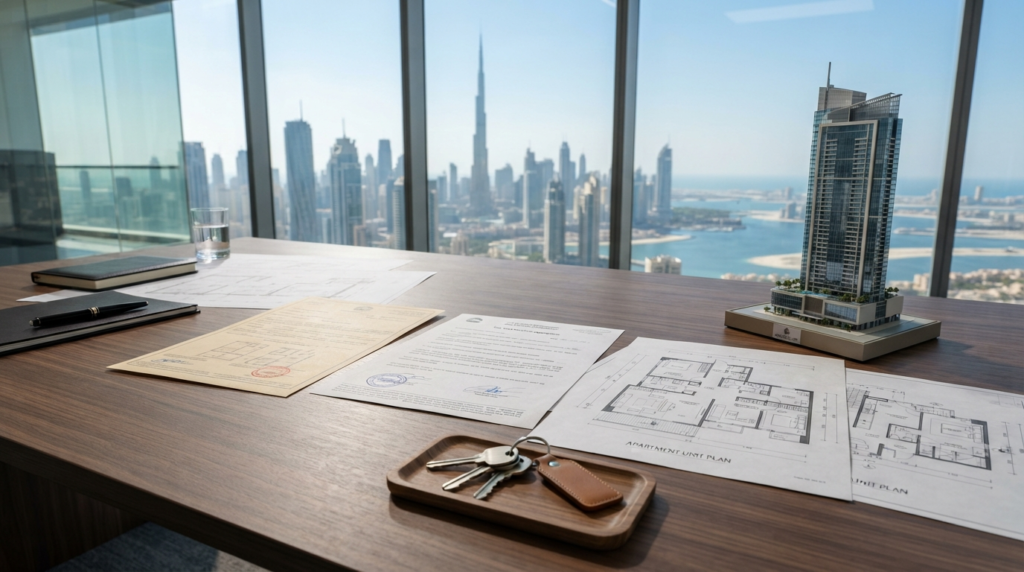
Oqood is the DLD’s interim (provisional) registration system for off-plan property. When you sign a Sale and Purchase Agreement (SPA) for a unit that hasn’t been completed yet, the developer registers that sale in the Oqood system rather than issuing a full title deed. The Oqood certificate becomes your official proof of ownership rights in that specific unit while construction is underway.
It matters because a private SPA with a developer, on its own, doesn’t give you a government-recorded interest in the property. Oqood registration does. It links your purchase to the project’s DLD file, ties your payments to an approved escrow account, and gives you a documented position that can, in most cases, be resold or transferred before handover.
Oqood vs. Title Deed: What’s the Difference?
| Oqood Certificate | Title Deed | |
|---|---|---|
| Applies to | Off-plan property, pre-handover | Completed, ready property |
| Issued by | DLD, at SPA registration | DLD, at handover |
| Legal status | Interim registered interest | Full, final ownership |
| Typical use | Resale before completion, payment tracking | Mortgages, Golden Visa, utility connection |
At handover, once snagging is cleared and the final payment is made, the Oqood record converts into a full title deed (sometimes referred to as Tasjeel) — the definitive ownership document.
The 5 Essential Steps for a Safe Oqood Purchase
Step 1: Verify the Developer and Project Are Officially Registered
Before signing anything, confirm two things independently — don’t rely on the sales brochure:
- The developer is licensed and listed in Dubai’s Trakheesi permit system, which governs marketing and sales activity for real estate projects.
- The project itself is registered with the DLD and RERA (Real Estate Regulatory Agency), with its unit plans and survey data on file.
You can check both through the DLD’s official digital channels (the Dubai REST app or dubailand.gov.ae) using the project name or the developer’s trade license number. If a project isn’t showing up in these systems, that’s a hard stop — walk away, regardless of how attractive the payment plan looks.
Step 2: Read the SPA Before You Sign — Not After
The Sale and Purchase Agreement is the document Oqood registration is built on, so its terms matter more than almost anything else in the transaction. Before signing, check for:
- The exact payment schedule and what construction milestone triggers each installment
- The stated handover date and any penalty clause if the developer misses it
- Escrow account details (account number and trustee bank)
- Your rights if the project is delayed, cancelled, or materially changed
Many buyers treat the SPA as a formality and only read it closely when something goes wrong. Have a property lawyer or a licensed conveyancer review it first — the cost is small compared to what an unfavorable clause can cost later.
Step 3: Confirm Your Oqood Registration and Understand the Fees
Once the SPA is signed, the developer is responsible for registering it in Oqood. Don’t assume this happens automatically or immediately — ask for written confirmation and a copy of the Oqood certificate.
On fees: the DLD charges a registration fee of 4% of the property’s declared sale value. Officially this is split 2% seller / 2% buyer, but in standard Dubai market practice, the buyer pays the full 4%. On top of that, budget for the small AED 10 Knowledge Fee and AED 10 Innovation Fee, plus title and map admin charges. If your purchase involves a mortgage, an additional 0.25% of the mortgage value applies for registering the initial mortgage alongside the sale.
| Fee | Approximate Amount |
|---|---|
| DLD registration fee | 4% of property value |
| Knowledge Fee | AED 10 |
| Innovation Fee | AED 10 |
| Mortgage registration (if financed) | 0.25% of mortgage value |
| Title/map admin fees | Small fixed charges |
Ask your developer or trustee office for a written fee breakdown before you pay — some developers run promotions that cover part or all of the DLD fee as a launch incentive, which is legitimate but should be confirmed in writing, not verbally.
Step 4: Keep Payments Tied to the Escrow Account and Construction Milestones
Every legitimate off-plan project in Dubai is required to route buyer payments through a DLD-approved escrow account, not directly to the developer’s general operating account. This is one of the strongest protections built into the system — it stops a developer from spending your money on unrelated projects.
As a buyer, you should:
- Confirm the escrow account details on your payment receipts match what’s stated in the SPA
- Never wire funds to a personal account, an agent’s account, or an account not named in your contract
- Track that each installment lines up with the construction milestone it’s supposed to be tied to (foundation, structural stages, roof slab, fit-out), rather than paying on a fixed calendar regardless of progress
If a developer or broker asks you to pay outside the escrow structure “for a discount,” treat that as a serious red flag.
Step 5: Track the Conversion to Title Deed at Handover
Oqood isn’t the finish line — it’s the interim stage. Once construction is complete, snagging issues are resolved, and your final payment clears, the developer applies to the DLD to convert your Oqood registration into a full title deed. At this point:
- You’ll also need to connect utilities (DEWA) before occupying the unit
- The 4% DLD fee is not charged again — it was already collected at Oqood registration and covers the full lifecycle through to title deed
- If you’re planning to use the property for Golden Visa eligibility (AED 2 million or above), be aware that a title deed is generally viewed as stronger supporting evidence than an Oqood certificate alone, so confirm current requirements with a licensed advisor before applying
Keep every document from this stage — the original Oqood certificate, escrow payment receipts, snagging reports, and the final title deed — in one file. You’ll need them for resale, refinancing, or visa applications down the line.
Common Mistakes to Avoid
- Assuming the sales agent’s word is enough. Always verify registration status independently through official DLD channels.
- Paying before confirming the escrow account. Funds sent outside escrow have little to no protection.
- Not chasing the Oqood certificate. If it hasn’t arrived within the timeframe your developer quoted, follow up in writing — delays sometimes signal deeper registration problems.
- Ignoring the SPA’s delay and cancellation clauses. These matter far more than the marketing brochure once construction hits a snag.
- Forgetting mortgage registration fees. Financed buyers are sometimes surprised by the extra 0.25% charge.
Frequently Asked Questions
What is Oqood in Dubai property registration?
Oqood is the Dubai Land Department’s interim registration system for off-plan property. It records a buyer’s rights in a unit under construction after the SPA is signed, before a full title deed is issued at handover.
How much does Oqood registration cost?
The core cost is the DLD’s 4% registration fee based on the property’s declared sale value, plus small Knowledge and Innovation fees. If the purchase is mortgaged, an additional 0.25% mortgage registration fee applies.
Do I pay the 4% DLD fee twice — once at Oqood and again at handover?
No. The 4% fee paid at Oqood registration covers the property through to title deed conversion at handover; it isn’t charged again.
How long does it take to get an Oqood certificate after signing the SPA?
Timelines vary by developer, but many major developers issue the certificate within roughly 10–14 business days of SPA signature. Ask your developer for their specific timeline in writing.
Can I resell a property before it’s finished if it’s only Oqood-registered?
In most cases, yes — an Oqood-registered interest can be transferred or resold before handover, subject to the developer’s and DLD’s resale procedures and any conditions in the original SPA.
Does an Oqood certificate qualify for the Dubai Golden Visa?
It can, depending on investment value and payment stage, but a title deed is generally considered stronger supporting evidence. Confirm current Golden Visa property requirements with a licensed advisor before applying.
Who needs the Dubai Property Oqood Guide?
The Dubai Property Oqood Guide is useful for anyone buying an off-plan property in Dubai. It explains how Oqood registration works before a title deed is issued.
Is the Dubai Property Oqood Guide only for off-plan properties?
Yes. The Dubai Property Oqood Guide primarily applies to off-plan properties because Oqood is the interim registration system used before project completion.
Can foreigners benefit from the Dubai Property Oqood Guide?
Absolutely. The Dubai Property Oqood Guide helps international buyers understand the registration process, fees, ownership rights, and documentation required for off-plan investments.
Why is the Dubai Property Oqood Guide important for investors?
The Dubai Property Oqood Guide helps investors understand their legal rights, registration obligations, and key procedures before purchasing an off-plan property in Dubai.
Does the Dubai Property Oqood Guide explain ownership rights?
Yes. A comprehensive Dubai Property Oqood Guide explains how Oqood registration records a buyer’s ownership interest until the official title deed is issued.
Can the Dubai Property Oqood Guide help first-time buyers?
Yes. The Dubai Property Oqood Guide is especially valuable for first-time buyers who want to understand off-plan property registration and avoid common mistakes.
What documents are commonly required in the Dubai Property Oqood Guide?
A typical Dubai Property Oqood Guide covers documents such as the signed Sale and Purchase Agreement (SPA), passport copy, Emirates ID (if applicable), and payment confirmation, although requirements may vary by developer.
Does the Dubai Property Oqood Guide cover title deed conversion?
Yes. The Dubai Property Oqood Guide explains that Oqood registration is converted into a title deed after construction is completed and all transfer requirements have been fulfilled.
Is the Dubai Property Oqood Guide relevant for mortgage buyers?
Yes. The Dubai Property Oqood Guide includes useful information for buyers financing an off-plan property through a mortgage, including registration requirements and related fees.
Should I read a Dubai Property Oqood Guide before buying off-plan?
Yes. Reading a Dubai Property Oqood Guide before signing an SPA can help you understand the registration process, expected costs, legal procedures, and your rights as an off-plan property buyer.
Final Thought
Oqood registration is what turns an off-plan promise into a legally recognized interest in a real, DLD-tracked property. Following these five steps — verifying the developer and project, reading the SPA carefully, confirming registration and fees, protecting your payments through escrow, and tracking the eventual conversion to title deed — is the difference between a safe off-plan purchase and an expensive lesson. When in doubt at any stage, verify directly with the Dubai Land Department or a licensed UAE property professional rather than relying on a sales pitch.
This guide is for general information only and does not constitute legal or financial advice. Regulations and fees are subject to change — always confirm current requirements directly with the Dubai Land Department (dubailand.gov.ae) before transacting.