Business Bay vs Dubai Creek Harbour
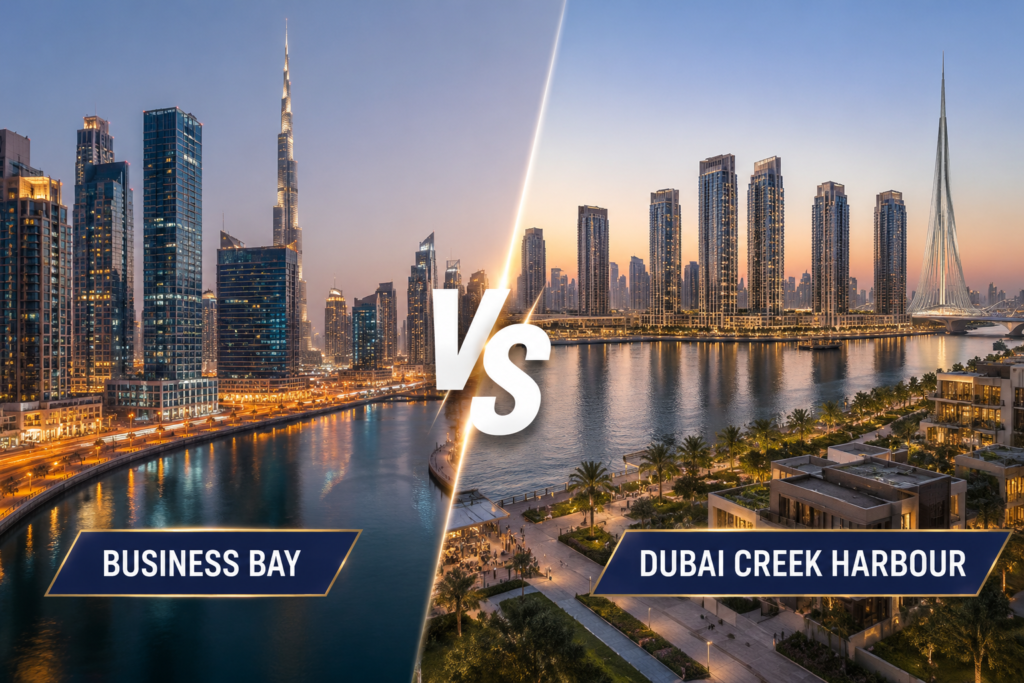
If you’re comparing Business Bay vs Dubai Creek Harbour for your next Dubai property purchase, the honest answer is that you’re really choosing between two different investment personalities. Business Bay is a mature, fully-let central business district that hands you cash flow from day one. Dubai Creek Harbour is a still-maturing Emaar waterfront masterplan that asks for patience in exchange for a bigger capital gain later. Neither is “better” in the abstract — the right pick depends on whether you need income now or appreciation later.
This guide breaks down current yields, price per square foot, growth drivers, and risk factors in both communities so you can match the numbers to your own investment horizon.
Quick Verdict
| Category | Winner |
|---|---|
| Rental income today | Business Bay |
| Capital growth potential | Dubai Creek Harbour |
| Lower entry price | Dubai Creek Harbour |
| Liquidity / resale speed | Business Bay |
| Best for 3–5 year hold | Business Bay |
| Best for 5–10 year hold | Dubai Creek Harbour |
Business Bay at a Glance
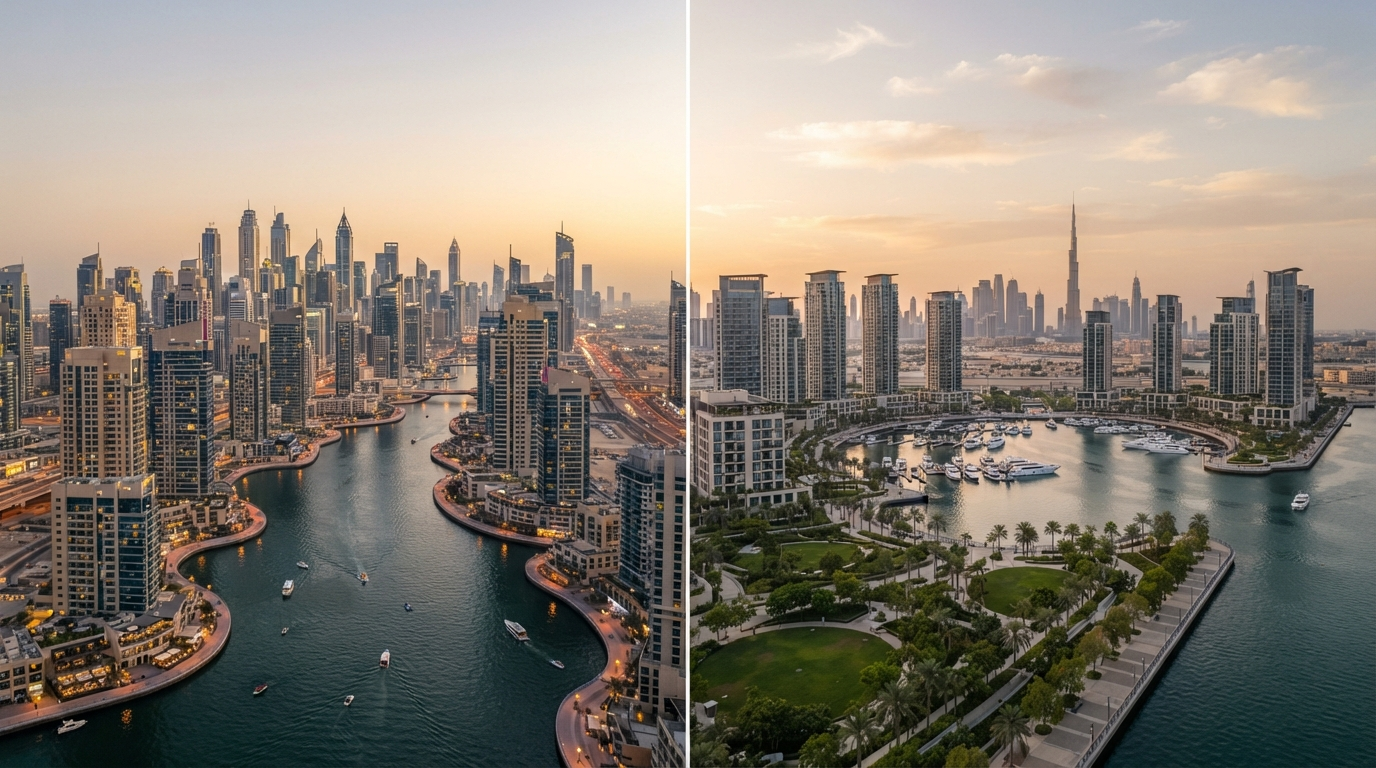
Business Bay sits on the Dubai Water Canal, wedged between Sheikh Zayed Road and Downtown Dubai, and functions as Dubai’s secondary central business district. It’s built out — towers are delivered, the tenant base is established, and corporate demand from nearby offices keeps apartments consistently occupied.
Average sale prices in Business Bay run roughly AED 1,400–1,580 per square foot, with a one-bedroom apartment typically priced between AED 900,000 and AED 1.2 million. Overall unit prices across the district range from about AED 1.5 million to AED 3 million depending on tower age and finish.
Dubai Creek Harbour at a Glance
Dubai Creek Harbour is Emaar’s flagship waterfront masterplan on the historic creek in eastern Dubai — roughly twice the physical size of Downtown Dubai and planned to eventually house more than 200,000 residents across nine districts. It’s still mid-cycle: some pockets (Creek Beach, parts of the Island District) are fully delivered and tenanted, while other zones are still under construction.
Average prices sit around AED 2,100–3,200 per square foot depending on the sub-district, with the masterplan average closer to AED 2,400–2,450 per square foot — a discount of roughly 25–35% versus comparable Downtown Dubai stock.
Rental Income Comparison
This is where the two communities diverge most clearly.
| Metric | Business Bay | Dubai Creek Harbour |
|---|---|---|
| Gross rental yield (typical apartment) | 5.5% – 7.6% | 5.8% – 7.5% |
| Studio/1-bed yield | Up to ~6.7% – 8% | 5.8% – 7.2% |
| Net yield (after service charges) | ~4.5% – 5.5% | Slightly lower in premium Island District stock |
| Occupancy | Strong — CBD corporate tenant base | 88%+ in completed towers |
| Service charges | AED 15–25 per sq ft | Comparable, offset by smart cooling systems in newer towers |
On paper, headline yield ranges look similar, but the underlying tenant economics differ. Business Bay’s rent is driven by professionals working in or near the district who want a short commute — that demand is proven and repeats every renewal cycle. Dubai Creek Harbour’s rental demand is newer and more waterfront-lifestyle driven; yields in its most-established sub-district (Creek Beach) run a touch lower than Business Bay’s average, while its priciest pocket (Island District, near the paused Dubai Creek Tower site) trades some yield for stronger long-term capital upside.
For pure, provable cash flow today, Business Bay has the edge — mainly because its rental market has a longer track record and a more diversified tenant base (corporate professionals plus a growing share of families).
Capital Growth Comparison
Flip the lens to appreciation and the picture reverses.
| Metric | Business Bay | Dubai Creek Harbour |
|---|---|---|
| Recent annual price growth | ~5–7% projected for 2026 | 8–12% annual appreciation forecasts |
| 5-year historical CAGR | Roughly 2% in some tracked datasets | Some delivered phases have seen ~25% cumulative growth |
| Key growth catalyst | Dubai 2040 Master Plan corridor designation | Blue Line Metro (operational ~2029), Dubai Creek Tower |
| Supply risk | High — 15,000+ new units in the 2026–2027 pipeline | Lower near-term risk; still land-rich for future phases |
| Maturity stage | Fully built, price-mature | Early-to-mid cycle, room to re-rate |
Dubai Creek Harbour’s growth argument rests on three things: it’s earlier in its development curve than Business Bay, it’s an Emaar-branded masterplan (which tends to command a resale premium once amenities activate), and it has a concrete infrastructure catalyst in the Blue Line Metro extension. Dubai’s metro history shows properties within around 500 meters of a new station have historically seen price jumps of 15–30% once the line goes live — and Creek Harbour buyers today are getting in before that’s priced in.
Business Bay’s growth case is more modest and steadier: it’s a finished product in a prime, unmovable central location, so appreciation is likely to track city-wide averages rather than outperform them. Its biggest headwind is the sheer volume of new supply still being delivered in and around the district through 2027, which could cap near-term price gains if absorption slows.
For capital growth over a 5–10 year horizon, Dubai Creek Harbour has the stronger, if less certain, story.
Risk Factors to Weigh
- Business Bay’s oversupply risk: With one of the largest new-unit pipelines of any Dubai district scheduled for 2026–2027, rental growth and resale pricing could soften if that stock isn’t absorbed quickly.
- Dubai Creek Harbour’s execution risk: Several of its long-term growth drivers — the Blue Line Metro and the Dubai Creek Tower — are multi-year infrastructure projects. Delays would push back the appreciation timeline. The Creek Tower project itself has been paused before.
- Liquidity: Business Bay has a longer resale and rental track record, meaning more historical transaction data and a faster typical resale timeline. Some Dubai Creek Harbour sub-districts still have thinner resale volumes simply because stock is newer.
Which One Fits Your Strategy?
- Want income you can rely on within 12 months? Business Bay’s established corporate tenant base and higher near-term net yields make it the more predictable cash-flow asset.
- Investing for a 5–10 year capital gain and comfortable holding off-plan or newly-delivered stock? Dubai Creek Harbour’s earlier price point and infrastructure catalysts offer more room to re-rate.
- Want both? A hybrid approach — a ready, high-yield unit in Business Bay for cash flow alongside an off-plan purchase in Dubai Creek Harbour for long-term upside — is a strategy several Dubai advisory firms are actively recommending for 2026.
- Golden Visa eligibility applies to both: properties of AED 2 million or more in either district qualify under current UAE rules.
Final Verdict
There’s no single “winner” between Business Bay and Dubai Creek Harbour — the honest framing is income now vs. growth later. Business Bay is the safer, cash-flow-first choice for investors who want a proven CBD rental market and faster liquidity. Dubai Creek Harbour is the higher-conviction, patience-required choice for investors betting on Emaar’s masterplan maturing and the Blue Line Metro delivering its historical price bump. Match the property to your holding period, not the headline yield number alone.
FAQ
Is Business Bay or Dubai Creek Harbour better for rental yield? Business Bay generally offers slightly steadier and, in several unit categories, higher net yields today thanks to its established corporate tenant base, with gross yields commonly ranging from about 5.5% to 7.6%.
Which area has better capital appreciation potential in 2026? Dubai Creek Harbour has the stronger appreciation story for 2026 and beyond, with forecasts in the 8–12% annual range driven by its earlier development stage and the upcoming Blue Line Metro.
Is Dubai Creek Harbour cheaper to buy into than Business Bay? Entry price per square foot is often higher in Dubai Creek Harbour’s premium sub-districts, but compared to nearby Downtown Dubai it trades at a 25–35% discount, and overall unit prices can be more accessible depending on the district and unit type chosen.
What is the biggest risk in Business Bay right now? The scale of new supply scheduled for delivery in 2026–2027 is the main risk — a large pipeline could slow rental growth or cap resale price gains if absorption doesn’t keep pace.
What is the biggest risk in Dubai Creek Harbour right now? Its long-term growth case depends partly on infrastructure delivery timelines, particularly the Blue Line Metro and the Dubai Creek Tower, both of which are multi-year projects that could shift the expected appreciation timeline if delayed.
Can I get a UAE Golden Visa by investing in either area? Yes. Properties valued at AED 2 million or more qualify for the 10-year Golden Visa in both Business Bay and Dubai Creek Harbour under current rules.
Which is the better choice for a first-time Dubai property investor? Business Bay tends to suit first-time investors who prioritize a shorter, more predictable path to rental income and easier resale, while Dubai Creek Harbour suits investors comfortable holding for longer in exchange for greater upside potential.