Dubai Holiday Home Investment: 8 Opportunities for Investors (2026)
Introduction
Dubai’s short-term rental market has quietly become one of the most talked-about corners of the emirate’s property scene. Tourists keep arriving, long-stay business travelers keep needing furnished units, and owners keep discovering that a well-run holiday home can out-earn a standard annual lease by a wide margin. But “holiday home investment” isn’t a single strategy — it’s a bundle of decisions about location, licensing, management, and risk that together determine whether a property becomes a reliable income generator or an expensive headache.
This guide breaks Dubai holiday home investment into eight concrete opportunities, explains the regulatory groundwork every investor needs first, and gives you a realistic picture of costs, yields, and pitfalls — so you can decide where your capital actually belongs.
Quick Answer
Dubai holiday home investment means buying a residential unit and renting it short-term (under 30 days, sometimes up to six months) through a Department of Economy and Tourism (DET, formerly DTCM) holiday home permit. Done well, it can produce gross yields in the <cite index=”9-1″>8–12% range in tourist-heavy districts like Dubai Marina, Downtown, and Palm Jumeirah, compared with roughly 5–6% on a standard annual lease</cite>, though management fees, licensing costs, and occupancy swings eat into that headline number. The eight opportunities below cover the areas, structures, and strategies that make the difference between an average return and a strong one.
Why Dubai’s Holiday Home Market Is Drawing Investors
Three structural factors explain the current interest. First, Dubai has no personal income tax and no capital gains tax on property sales, which means gross rental income is closer to net income than in most comparable markets — a meaningful difference when you’re comparing yields against London, New York, or Singapore. Second, the regulatory system is unusually mature: the holiday home framework traces back to <cite index=”3-1″>Decree No. 41 of 2013, and the sector now has more than 40,000 licensed properties generating substantial tourism revenue</cite>. Third, demand keeps diversifying — it’s no longer just leisure tourists booking a week in Marina; it’s consultants on three-month assignments, relocating families waiting for a long-term unit, and event visitors during trade fairs and conferences.
None of that guarantees a good return on any specific unit. Yield depends heavily on location, unit type, and how seriously you take compliance and management — which is exactly why the opportunities below are organized by strategy rather than treated as one generic pitch.
What You Need Before You Buy: The Licensing Reality
Before evaluating locations, understand the legal foundation, because it shapes your cost base and who can help you run the property.
Short-term rentals in Dubai — anything under roughly six to twelve months, depending on the arrangement — <cite index=”5-1″>fall under DET/DTCM jurisdiction rather than the Dubai Land Department’s standard tenancy system, and are not registered on Ejari the way long-term leases are</cite>. You have two licensing paths:
- Individual owner permit — you hold the DET holiday home permit yourself and manage bookings, guest registration, and compliance directly.
- Licensed operator model — a management company holds the operator license and runs the unit (or a portfolio of units) on your behalf.
<cite index=”2-1″>Most owners in Dubai use a licensed operator, because the compliance workload — permits, guest ID verification, tourism dirham collection, inspections, annual renewals — is significant and ongoing, and management fees typically run 15–20% of booking revenue</cite>. Required documents generally include the <cite index=”4-1″>title deed, passport or Emirates ID, an NOC from the developer or owners’ association, and a recent DEWA bill</cite>, plus proof the unit meets DET furnishing and safety standards, including installed smoke detectors and a first-aid kit.
On cost, budget for the permit itself plus incidental fees. Recent guidance puts the <cite index=”4-1″>DET holiday home permit at roughly AED 1,520 per unit per year, with operators needing an additional DED trade license costing around AED 10,000–15,000 annually</cite>. Other sources estimate <cite index=”9-1″>licensing closer to AED 1,500 per bedroom per year</cite> — the exact figure varies by property size and classification, so confirm current fees directly with DET before budgeting precisely.
Opportunity 1 — Waterfront Tourist Hubs (Marina, JBR, Palm Jumeirah)
This is the highest-profile opportunity and, for good reason, the most competitive. Waterfront districts pull consistent leisure demand year-round, with peak pricing power in the cooler months.
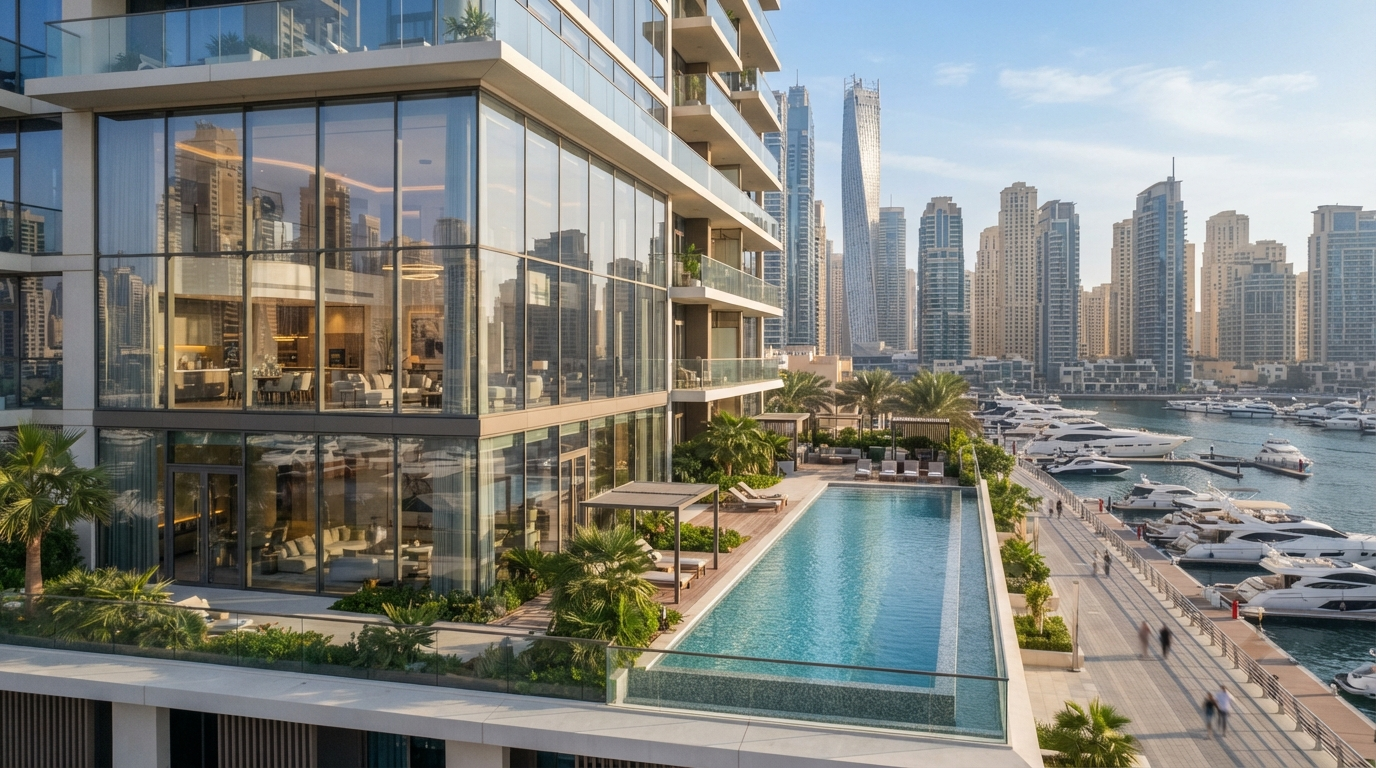
<cite index=”9-1″>A well-managed short-term rental in Marina can achieve 8–12% gross yield versus 5–6% on a standard annual lease</cite>, and <cite index=”9-1″>average daily rates across Marina, Downtown, Business Bay, JBR, and Palm Jumeirah run roughly AED 400–1,200 depending on season and unit type</cite>. The trade-off is that <cite index=”9-1″>occupancy in these zones typically averages 70–80%, and management fees run 15–25% of revenue</cite> — so the headline gross number needs a realistic haircut before you treat it as spendable income.
Who this suits: investors with a higher entry budget who want brand-name locations, strong resale liquidity, and demand that doesn’t rely on a single season.
Opportunity 2 — Downtown and Business Bay for Corporate Short Stays
Downtown Dubai and Business Bay draw a different guest profile — business travelers, conference attendees, and relocating professionals — which smooths out some of the leisure-season swings you see in pure beach locations.
<cite index=”14-1″>Business Bay remains one of Dubai’s top areas for short-term rentals, with proximity to Downtown and DIFC creating strong year-round demand from business travelers, tourists, entrepreneurs, and working professionals</cite>. One cited example put a Business Bay tower’s average short-term yield at <cite index=”14-1″>around 7.4%</cite>, while broader estimates for the district range up to <cite index=”8-1″>6–8%</cite>.
Who this suits: investors who want a hedge against pure tourism seasonality by capturing corporate and MICE (meetings, incentives, conferences, exhibitions) traffic alongside leisure guests.
Opportunity 3 — Yield-Focused Secondary Communities (JVC and Similar)
Not every strong opportunity sits on the waterfront. Jumeirah Village Circle (JVC) has become a favorite among yield-focused investors specifically because entry prices are lower while tenant and short-stay demand has stayed strong.
<cite index=”8-1″>JVC delivers gross yields around 7–9%, helped by affordable entry prices and strong tenant demand</cite>, and one analysis pegs it even higher, citing <cite index=”11-1″>gross yields of 8.5–9.5% across property types, with studios starting from roughly AED 450,000</cite>. Other emerging or budget-friendly pockets worth watching include areas near Al Maktoum Airport and logistics hubs, where analysts expect <cite index=”13-1″>yields to stay above 8.5% as workforce demand grows, plus overlooked districts like Arjan and Liwan that offer lower price points with rising ROI</cite>.
Who this suits: investors prioritizing yield percentage and lower capital outlay over trophy-location prestige.
Opportunity 4 — Off-Plan Purchases Timed for Furnished Handover
Buying off-plan and configuring the unit for holiday-home use from day one is an opportunity many investors overlook. <cite index=”11-1″>Off-plan properties purchased during launch phases are typically 10–15% below market price at handover, which effectively boosts yield from the outset</cite>.
The added step for a holiday-home strategy: plan the furnishing package, DET permit application, and operator relationship before handover, so the unit starts earning from month one instead of sitting vacant while you scramble to license and furnish it after the fact.
Who this suits: investors comfortable with construction-period risk who want a lower cost basis baked in before the property ever takes a guest.
Opportunity 5 — Golden Visa-Linked Portfolio Building
For investors thinking beyond pure yield, Dubai property can also unlock long-term UAE residency. <cite index=”16-1″>Property investors who own real estate worth at least AED 2,000,000, confirmed by a Dubai Land Department title deed or licensed valuation, qualify for a 10-year renewable Golden Residence Permit</cite>, and as of <cite index=”16-1″>a February 2026 policy update, there is no minimum paid-down requirement and mortgaged property can qualify</cite>. <cite index=”22-1″>The AED 2 million threshold can be met with a single property or by combining several properties registered under your name</cite>.
This matters for holiday home investors because a portfolio of two or three smaller short-term rental units — say, in JVC or Business Bay — can be structured to collectively clear the AED 2 million threshold, giving you both rental income and residency in one strategy.
Who this suits: overseas investors who want a foothold in the UAE beyond a rental check — residency, banking access, and a base for family or business.
Opportunity 6 — Professional Management Partnerships
Given how compliance-heavy the Dubai short-term rental system is, treating “who manages this property” as a core investment decision — not an afterthought — is itself an opportunity. <cite index=”2-1″>A licensed operator handles guest registration, cleaning, maintenance coordination, pricing, distribution, and DET compliance on the owner’s behalf, typically for 15–20% of booking revenue</cite>.
The upside of paying that fee is real: professional operators generally achieve higher occupancy through dynamic pricing and multi-platform distribution than a self-managed listing can, which is why <cite index=”9-1″>even with management fees of 15–25%, the net yield uplift from short-term versus long-term leasing is still typically 1–3 percentage points</cite>.
Who this suits: absentee owners, first-time short-term rental investors, or anyone who doesn’t want to personally handle guest turnover and DET paperwork.
Opportunity 7 — Hybrid Long/Short Stay Flexibility
A less obvious opportunity is designing a unit to flex between short and medium stays depending on demand. Because the regulatory line sits at roughly the 30-day to six-month mark, an owner can pivot a property between DTCM-licensed holiday-home bookings and monthly furnished lets without switching to the long-term Ejari system, as long as each arrangement is documented under the correct regime. <cite index=”5-1″>Anything under 12 months typically falls under DTCM/DET jurisdiction and requires a holiday-home license rather than the standard DLD tenancy contract</cite>.
This flexibility lets owners chase whichever booking length is paying better in a given month — nightly rates during a trade-fair week, or a steadier monthly corporate booking during quieter stretches — without restructuring the whole business.
Who this suits: investors in mixed-demand districts (Business Bay, JLT) who want to avoid total dependence on nightly tourist bookings.
Opportunity 8 — Niche and Family-Sized Villas
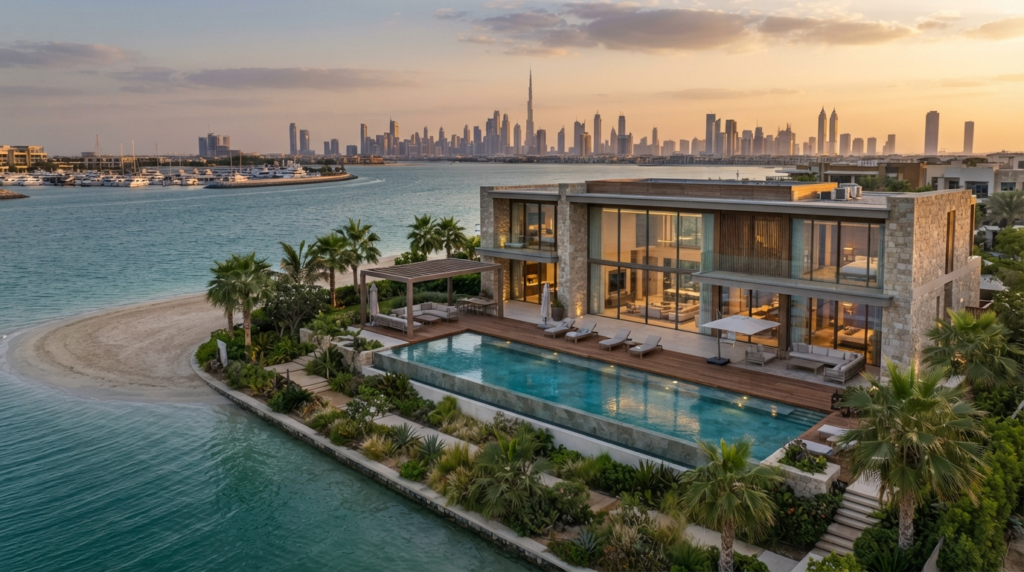
Most holiday-home commentary focuses on apartments, but larger villas and townhouses serve a distinct, less crowded niche: multi-generational family groups and long-stay leisure visitors who specifically avoid hotel rooms and standard apartments. Villa yields tend to run lower on a percentage basis — <cite index=”12-1″>villas and townhouses average around 4.98% versus roughly 7.15% for apartments</cite> — but the absolute nightly rate for a licensed, well-located villa can be substantial, and competition from other holiday-home listings is thinner than in the saturated studio and one-bedroom segment.
Who this suits: investors with a larger budget who want to differentiate rather than compete head-on in the crowded apartment short-stay market.
Comparison Table: Gross Yield Potential by Strategy
| Strategy / Area | Typical Gross Yield | Entry Cost Profile | Guest Profile | Management Intensity |
|---|---|---|---|---|
| Marina / JBR / Palm | 8–12% (short-term) | High | Leisure tourists | High — best via operator |
| Downtown / Business Bay | 6–8% | High | Business + leisure mix | Moderate–High |
| JVC / secondary communities | 7–9.5% | Low–Moderate | Value-focused tenants & guests | Moderate |
| Off-plan, furnished at handover | Yield varies, cost basis 10–15% lower | Moderate | Depends on final location | Moderate |
| Golden Visa portfolio (multi-unit) | Blended, secondary goal is residency | Moderate–High (AED 2M total) | Mixed | Moderate–High |
| Villas / larger units | ~5% | High | Families, long-stay groups | Moderate |
Note: figures reflect ranges reported across multiple 2026 market sources and vary by exact building, seasonality, and management quality. Always confirm current numbers with a licensed agent or DET before committing capital.
The Real Cost Structure Nobody Puts on the Brochure
Every one of the eight opportunities above shares the same cost skeleton, and skipping this section is the single biggest reason first-time investors miscalculate returns.
- DET holiday home permit: <cite index=”4-1″>around AED 1,520 per unit per year</cite> for individual owners; operators need an additional trade license.
- Management fees: <cite index=”2-1″>typically 15–20%</cite> of booking revenue, sometimes quoted as high as <cite index=”9-1″>15–25%</cite> depending on service scope.
- Service charges: <cite index=”9-1″>roughly AED 12–18 per square foot in affordable areas like JVC, rising to AED 25–35 per square foot in premium areas like Downtown and DIFC — on a 1,000 sq ft apartment, that’s AED 12,000–35,000 a year, cutting net yield by 1–3 percentage points</cite>.
- Furnishing: a one-time (and periodically refreshed) cost, but <cite index=”12-1″>fully furnished units can earn 10–25% more in annual rent than unfurnished equivalents</cite>, so it typically pays for itself.
- Tourism Dirham and guest-related fees: a small per-night charge collected from guests and remitted to the authorities, plus periodic inspection or renewal costs.
The pattern across almost every credible 2026 source is consistent: gross short-term yield beats long-term leasing by roughly <cite index=”9-1″>1–3 percentage points net, after fees</cite> — meaningful, but nowhere near as dramatic as raw gross-yield marketing numbers suggest.
Common Mistakes First-Time Holiday Home Investors Make
- Budgeting from gross yield figures instead of net, after management fees, service charges, and licensing.
- Buying a unit before confirming the building’s owners’ association actually permits holiday-home use — an NOC is required, and not every building allows it.
- Skipping professional management to save 15–20%, then losing far more than that in poor occupancy and guest-review damage.
- Treating every district as interchangeable, when guest demand, seasonality, and price competition vary sharply between, say, Palm Jumeirah and a secondary community.
- Ignoring the furnishing and safety-standard requirements until after purchase, which delays the permit and pushes back your first booking.
Troubleshooting: When Your Holiday Home Underperforms
If occupancy or income falls short of projections, work through this sequence:
- Check pricing against comparable licensed listings in the same building or street — outdated or static pricing is the most common, most fixable issue.
- Review your management agreement’s marketing reach — is the unit listed across multiple platforms, or only one?
- Confirm the permit and compliance status are current — a lapsed permit can silently pull a listing from major platforms.
- Reassess the guest profile fit — a studio marketed to families, or a business-district unit marketed only for leisure stays, often underperforms simply from a positioning mismatch.
- Revisit service-charge and fee assumptions — sometimes the “underperformance” is really an underestimated cost base, not a revenue problem.
Expert Tips for Getting This Right
- Model returns on net, not gross, yield from day one — build management fees and service charges into your first-year projection, not as an afterthought.
- If pursuing the Golden Visa route alongside rental income, confirm your combined portfolio valuation with a <cite index=”22-1″>DLD-licensed valuation office</cite>, since informal estimates aren’t accepted.
- Treat the operator relationship as a partnership to be interviewed, not a commodity service — ask for occupancy and review-score data from comparable units they already manage.
- Match the furnishing tier to the guest profile: a Marina tourist unit and a Business Bay corporate unit call for different design and amenity choices.
FAQs
Is Dubai holiday home investment profitable in 2026?
It can be, particularly in tourist-heavy or business-travel districts, but profitability depends on net yield after management fees, service charges, and licensing costs — not the gross figures often used in marketing.
Do I need a license to run a holiday home in Dubai?
Yes. <cite index=”4-1″>Anyone offering a residential property for stays shorter than six months must hold a valid DET (formerly DTCM) holiday home permit</cite>, whether managed personally or through a licensed operator.
How much does a Dubai holiday home license cost?
Estimates vary by source and unit size, with figures around <cite index=”4-1″>AED 1,520 per unit per year</cite> for individual permits, and <cite index=”9-1″>roughly AED 1,500 per bedroom per year</cite> cited elsewhere. Confirm current fees directly with DET before budgeting.
Which areas offer the best short-term rental yields in Dubai?
<cite index=”9-1″>Marina, Downtown, Business Bay, JBR, and Palm Jumeirah</cite> lead on tourist demand and daily rates, while <cite index=”11-1″>JVC leads on pure gross yield percentage</cite> thanks to lower entry prices.
Can a holiday home investment help me get a Golden Visa?
Yes, if the property (or combined properties) reaches the <cite index=”16-1″>AED 2,000,000 threshold confirmed by DLD valuation</cite>, you can qualify for a 10-year renewable residency independent of the rental strategy.
Should I self-manage or use a licensed operator?
<cite index=”2-1″>Most owners in Dubai use a licensed operator because the ongoing compliance workload is significant</cite>; self-management can save on fees but demands real time and local presence.
Is Dubai Holiday Home Investment suitable for first time investors?
Yes. Dubai Holiday Home Investment can be suitable for first-time investors who understand licensing requirements, operating costs, occupancy rates, and local regulations before purchasing.
Can foreigners invest in Dubai Holiday Home Investment?
Yes. Dubai Holiday Home Investment is open to eligible foreign buyers in Dubai’s designated freehold areas, making it a popular option for international investors.
Which property types are best for Dubai Holiday Home Investment?
Studios, one-bedroom apartments, waterfront homes, and furnished luxury properties are among the most popular options for Dubai Holiday Home Investment, depending on the target guest market.
What are the main benefits of Dubai Holiday Home Investment?
The main advantages of Dubai Holiday Home Investment include potential rental income, flexible personal use, strong tourism demand, and long-term capital appreciation.
Does Dubai Holiday Home Investment require a holiday home permit?
Yes. Dubai Holiday Home Investment typically requires the property to be registered and licensed under the relevant Dubai regulations before it can be legally rented as a holiday home.
Is Dubai Holiday Home Investment better than long term renting?
Whether Dubai Holiday Home Investment performs better than long-term renting depends on occupancy levels, management costs, seasonality, and your overall investment strategy.
What expenses should I consider with Dubai Holiday Home Investment?
When planning Dubai Holiday Home Investment, consider service charges, maintenance, furnishing, utilities, licensing fees, property management costs, and marketing expenses.
Which areas are popular for Dubai Holiday Home Investment?
Popular locations for Dubai Holiday Home Investment include Downtown Dubai, Dubai Marina, Palm Jumeirah, Business Bay, JBR, and Dubai Creek Harbour due to their strong visitor demand.
Can I manage my own Dubai Holiday Home Investment?
Yes. Owners may self-manage a Dubai Holiday Home Investment if they comply with Dubai’s holiday home regulations, or they can appoint a licensed property management company.
Is Dubai Holiday Home Investment a good long term strategy?
For many investors, Dubai Holiday Home Investment can be part of a diversified long-term portfolio, especially when supported by strong tourism demand, careful property selection, and realistic return expectations.
Key Takeaways
- Dubai holiday home investment can outperform standard leasing, but the realistic net uplift is closer to a few percentage points than the eye-catching gross figures suggest.
- Licensing through DET is mandatory and shapes your entire cost structure — budget for it before you budget for furniture.
- Location strategy should match your goal: waterfront tourism, business-travel resilience, pure yield, or Golden Visa eligibility all point toward different districts.
- Professional management is the norm, not the exception, given the compliance load.
- Villas, off-plan timing, and hybrid short/long stay flexibility are underused opportunities worth evaluating alongside the obvious apartment-in-Marina play.
Final Verdict
Dubai’s holiday home market rewards investors who treat it as an operating business, not a passive purchase. The eight opportunities above aren’t equally accessible to every budget, but each represents a genuine, currently active path — backed by 2026 market data — for turning a Dubai property into a short-term rental income stream. The investors who do best are the ones who model net returns honestly, secure the right license before day one, and choose a location and management structure aligned to a clear guest profile, rather than chasing the highest headline yield they can find in a listing ad.
Sources Referenced
- Houst — Dubai Airbnb Rules: DTCM Holiday Home Permit Guide (2026)
- GateIn — DTCM Holiday Home Dubai 2026: The Complete License Guide
- Real Estate Club Dubai — Dubai Holiday Home License: DTCM Permit Guide 2026
- Tenancy Contract — Short-Term Rental Dubai 2026: DTCM Licence + Holiday Home Rules
- PropertyFinder — Short-Term Rental Investment in Dubai 2026
- Banke International Properties — Dubai Rental Yield 2026
- The Key Advisory — Dubai Rental Yield Guide 2026
- Asobr — Top 10 Best Areas for Rental Yield in Dubai 2026
- Engel & Völkers — Average Rental Yields in Dubai, 2026 Market Insights
- Westgate Dubai — Highest Rental Yield Areas in Dubai 2026
- Asset Homez — Best Apartments Dubai 2026: 10 Locations High ROI
- EGSH — Golden Visa Through Property Investment Dubai: 2026 Guide
- Astra Terra Properties — UAE Golden Visa Property Threshold 2026
- Property Network — Dubai’s Golden Visa & the AED 2 Million Property Threshold
- Al Maskan Properties — Dubai Golden Visa Through Property Investment: 2026 Guide
Note on facts and figures: yield, fee, and cost figures in this article are drawn from multiple industry sources published in 2026 and may vary by property, building, and season. Confirm current DET licensing fees and DLD valuation requirements directly with the relevant authorities before making an investment decision. This article is for informational purposes and is not financial, legal, or investment advice.