DAMAC vs Nakheel: 9 Proven Differences Every Investor Should Know (2026)
Introduction
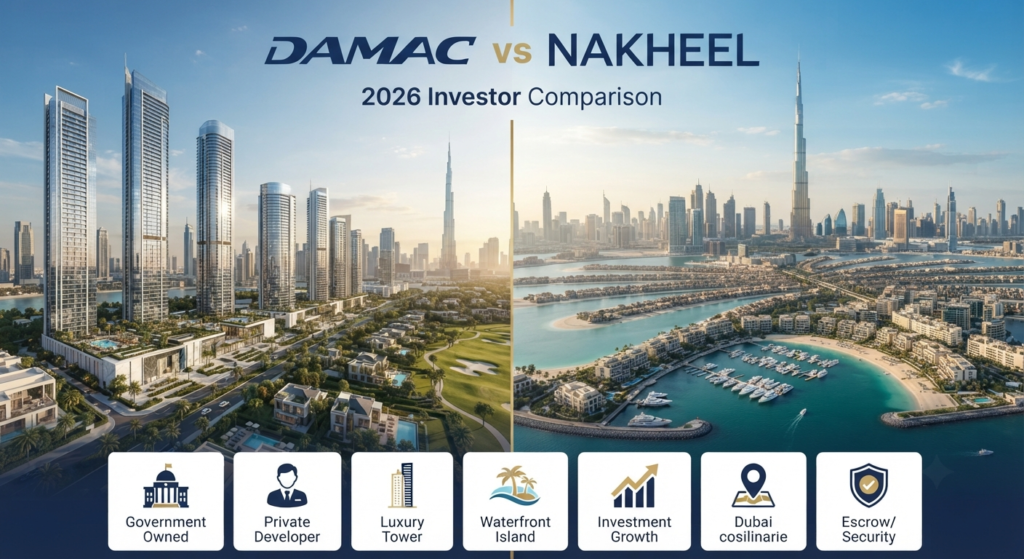
Anyone shortlisting Dubai developers eventually lands on the same two names outside of Emaar: DAMAC and Nakheel. Both are major forces in the emirate’s skyline, both sell heavily to overseas investors, and both get mentioned in the same breath in almost every “best Dubai developer” roundup. But they are built on almost opposite foundations — one is a privately held, founder-run company that grew out of a catering business; the other is a government-owned master developer created to reclaim land from the Arabian Gulf.
Those foundational differences shape everything downstream: how each company is financed, what kind of projects it builds, how it markets itself, and what kind of risk an investor is actually taking on. This guide breaks the comparison into nine concrete differences, backed by verifiable corporate history rather than marketing copy, so you can judge which developer actually fits your investment goals.
Quick Answer
DAMAC Properties is a privately owned luxury developer founded in 2002 by Emirati billionaire Hussain Sajwani, known for branded residences (Versace, Cavalli, Trump-affiliated projects) and high-rise towers aimed at yield-focused investors. Nakheel is a Dubai government-owned master developer behind Palm Jumeirah and The World, focused on large-scale land reclamation and waterfront communities, and carries the backing — and the post-2009 restructuring history — of a state-owned entity. Neither is “better” outright; the right choice depends on whether you prioritize branded high-yield product (DAMAC) or trophy waterfront assets with sovereign backing (Nakheel).
1. Ownership Structure
This is the single biggest structural difference, and it explains almost every other item on this list.
Nakheel is wholly owned by the Government of Dubai. It began as part of Dubai World, the state’s investment holding company, before being separated out during the 2009–2011 debt restructuring and placed directly under government ownership. Its chairman and board answer to the Dubai government rather than public shareholders.
DAMAC Properties is privately held. Hussain Sajwani founded it in 2002, took it public via a London Stock Exchange global depository receipt program in 2013 before listing on the Dubai Financial Market in 2015, and then led a move to take the company private again in 2021. Today DAMAC operates as a founder-controlled private company under the wider DAMAC Group.
Why it matters: a state-owned developer carries an implicit (not guaranteed) layer of government interest in its survival, while a privately held developer’s stability rests on the founder’s balance sheet and market execution.
2. Founding Story and Corporate History
Nakheel was established in the early 2000s specifically to execute Dubai’s land-reclamation ambitions — most notably Palm Jumeirah, an artificial peninsula shaped like a palm tree that added significant new coastline to the emirate. The company was purpose-built for infrastructure-scale projects, not retail-style tower sales.
DAMAC’s roots are commercial rather than governmental. Sajwani built his first business, a catering company, in the early 1980s, serving US military and construction-industry clients including Bechtel. When Dubai opened real estate to foreign freehold ownership in 2002, he pivoted into property and DAMAC Properties was born, selling out its first residential building in under six months.
Why it matters: Nakheel was designed around nation-building infrastructure; DAMAC was built around spotting and moving fast on a regulatory opportunity. That origin still shows in how each company designs and markets its projects today.
3. Core Project Type and Development Model
Nakheel’s signature output is land creation and master-planned communities: Palm Jumeirah, The World islands, the revived Palm Jebel Ali, Dubai Islands (formerly Deira Islands), and inland communities such as International City and Jumeirah Village. Its business model has historically depended on large infrastructure investment up front, monetized over long horizons through land sales, leasing, and more recently recurring-revenue assets like malls and hotels.
DAMAC’s model centers on high-rise residential towers and branded master communities built on land it acquires rather than reclaims — think Business Bay towers, Dubai Marina residences, and villa communities like DAMAC Hills and DAMAC Lagoons. Much of its portfolio leans on co-branding with luxury fashion and hospitality names to differentiate otherwise similar tower stock.
Why it matters: Nakheel sells a place (a stretch of coastline or an entire district); DAMAC sells a product (a specific branded unit inside a tower or community). That changes what actually drives resale value for each.
4. Financial and Listing History
Nakheel’s defining financial event is the 2009 Dubai World debt crisis, when its aggressive land-reclamation spending collided with the global financial crash. The Dubai government, backed by an Abu Dhabi loan, injected close to $10 billion to recapitalize Nakheel and restructure roughly $10.9 billion owed to trade creditors. The company finished repaying its restructuring-related sukuk by 2016 and has since rebuilt profitability, partly by adding recurring-revenue assets.
DAMAC’s financial arc runs the opposite direction on the public-markets side: private, to publicly listed (LSE GDR in 2013, DFM in 2015), and back to private again in 2021 under Sajwani. More recently, the group has diversified revenue outside core residential sales, including a push into data-center infrastructure under the DAMAC Digital brand.
Why it matters: Nakheel’s history includes a real, publicly documented restructuring event; DAMAC’s history includes going public and then private, which changes the transparency an outside investor can expect from each company today (a listed company files more, a private one files less).
5. Branding and Marketing Approach
DAMAC has built a distinctive, sometimes theatrical marketing identity: co-branded interiors with Versace, Roberto Cavalli, and Fendi, a Trump-affiliated golf development, and headline-grabbing buyer incentives such as free luxury cars tied to unit purchases. The brand plays deliberately to aspirational, lifestyle-driven buyers.
Nakheel’s brand equity comes from engineering scale and geography rather than co-branding — “living on the Palm” or owning a private island on The World carries its own cachet without needing a fashion-house tie-in. Its marketing leans on the rarity of waterfront land rather than interior design partnerships.
Why it matters: DAMAC’s branding is repeatable across many towers; Nakheel’s branding is tied to specific, finite locations, which affects long-term scarcity value.
6. Portfolio Diversification
DAMAC has diversified beyond residential towers into hospitality (DAMAC Hotels & Resorts), international markets, and — more recently — data-center and digital infrastructure investment through DAMAC Digital, alongside past forays into fashion and lifestyle brands under the wider DAMAC Group.
Nakheel diversified in a different direction after its restructuring: shifting some focus from capital-intensive island-building toward recurring-revenue assets such as retail malls (including Palm Jumeirah’s Nakheel Mall/Palm Jumeirah Mall), hotels, and leased commercial space, aiming for steadier cash flow than one-off land and villa sales.
Why it matters: both companies diversified for the same underlying reason — reducing dependence on cyclical unit sales — but through very different asset classes.
7. Geographic Footprint
DAMAC has pursued international expansion alongside its UAE core, with projects and brand presence extending into markets such as Saudi Arabia, Qatar, and the United Kingdom (including a Versace-branded tower in London), plus a wider history of activity across several Middle Eastern markets under the DAMAC Group.
Nakheel’s footprint is concentrated almost entirely within Dubai. Its mandate has always been building out Dubai’s own coastline and master communities rather than expanding the brand into other cities or countries.
Why it matters: if you want geographic diversification within a single developer relationship, DAMAC currently offers more of it; if you want deep, Dubai-specific waterfront concentration, Nakheel is the more singular bet.
8. Governance and Risk Profile
Nakheel operates under government board oversight, with its chairman appointed through Dubai’s ruling structure. That state ownership was directly tested in 2009, and the outcome — a government-funded rescue rather than a default — is the clearest evidence available of how the relationship between Nakheel and the Dubai government functions under stress. Post-restructuring, no major fresh debt distress has been publicly reported.
DAMAC’s governance sits with Sajwani as founder, chairman, and controlling owner, with the company’s risk profile tied more directly to real estate cycles, its own sales execution, and (during its listed years) public-market scrutiny. As a private company today, DAMAC discloses less than it did as a DFM-listed entity.
Why it matters: these are two genuinely different risk models — sovereign-linked backing with a documented crisis-and-rescue history on one side, founder-controlled private ownership on the other. Neither is inherently safer; they are differently exposed.
9. Typical Investor Profile
DAMAC tends to attract investors chasing rental yield and short-term appreciation, often furnishing units for the short-stay market, and buyers drawn to the brand-name interior finishes and flexible, sometimes aggressive, payment plans DAMAC is known for offering.
Nakheel tends to attract buyers focused on long-term capital preservation and lifestyle value — the “I own on the Palm” premium — plus investors who want direct exposure to Dubai’s most geographically constrained, hardest-to-replicate waterfront locations.
Why it matters: matching developer to strategy is more useful than asking which developer is “best” — the two are largely built for different investor goals.
Comparison Table
| Factor | DAMAC Properties | Nakheel |
|---|---|---|
| Ownership | Private, founder-controlled (Hussain Sajwani) | 100% Government of Dubai |
| Founded | 2002 (DAMAC Group dates to 1982) | Early 2000s, under Dubai World |
| Signature output | Branded towers, villa communities | Reclaimed islands, master-planned districts |
| Flagship projects | DAMAC Hills, DAMAC Lagoons, Business Bay towers | Palm Jumeirah, The World, Dubai Islands |
| Public markets history | LSE GDR (2013) → DFM listed (2015) → private (2021) | Never independently listed; state-owned throughout |
| Major financial event | Take-private transaction (2021) | 2009 Dubai World debt crisis and 2011 restructuring |
| Branding style | Celebrity/fashion co-branding, aggressive promotions | Landmark/geography-led branding |
| Geographic reach | UAE plus select international markets | Dubai-focused |
| Typical buyer | Yield and short-term rental focused | Lifestyle and long-term capital preservation focused |
Expert Tips
- Check whether you’re buying a brand (DAMAC’s interior/co-branding value) or a location (Nakheel’s land scarcity value) — they hold value differently in a downturn.
- Request the actual RERA project registration and escrow account details for any specific unit; developer-level reputation does not replace project-level due diligence.
- For Nakheel purchases, weigh the extra reassurance of state ownership against the fact that most of its highest-profile land was already built out years ago — the “next Palm Jumeirah” scarcity story is harder to repeat.
- For DAMAC purchases, stress-test any advertised rental yield against realistic occupancy for short-stay units, since headline yield figures assume high occupancy that is not guaranteed.
Common Mistakes
- Assuming government ownership means Nakheel purchases carry a government guarantee — Dubai’s 2009 support for Nakheel was a discretionary rescue of a strategic asset, not a legal guarantee to individual unit buyers.
- Assuming DAMAC’s past LSE/DFM listing still applies today — the company has been private since 2021, which changes what financial information is publicly available.
- Comparing a Nakheel waterfront villa directly against a DAMAC tower studio on price-per-square-foot alone, without adjusting for land scarcity, service charges, and community maturity.
- Treating marketing incentives (free cars, extended payment plans) as a proxy for underlying project quality rather than a cost the developer is pricing into the unit somewhere.
Troubleshooting: Due-Diligence Checklist
If you’re deciding between a DAMAC and a Nakheel project, work through this before signing anything:
- Confirm the specific project (not just the developer) is registered with Dubai’s Real Estate Regulatory Agency (RERA).
- Confirm an active escrow account exists for the project and ask for the escrow account number.
- Check the developer’s delivery history for comparable projects, not just headline flagship developments.
- Read the payment plan in full, including post-handover obligations.
- For DAMAC branded residences, clarify whether the brand license (fashion house, hospitality partner) is confirmed long-term or time-limited.
- For Nakheel projects, check the community’s build-out stage — an early-phase island district carries different risk than a fully delivered one like central Palm Jumeirah.
- Verify service charges for the specific building or community, since these vary significantly by project even within the same developer.
FAQs
Is Nakheel safer to invest with than DAMAC because it’s government-owned?
Government ownership means Nakheel has a documented history of receiving state support during the 2009 debt crisis, which is meaningfully different from a purely private company’s risk profile. It is not, however, a legal guarantee on any individual investor’s unit — project-level due diligence still matters regardless of who owns the developer.
Is DAMAC still a publicly listed company?
No. DAMAC listed via a London Stock Exchange GDR program in 2013 and on the Dubai Financial Market in 2015, then went private again in 2021 under Hussain Sajwani.
Which developer builds on the Palm Jumeirah?
Nakheel developed Palm Jumeirah, along with The World islands and the Dubai Islands (formerly Deira Islands) project.
Does DAMAC only build in Dubai?
No. DAMAC has projects and brand presence in other markets, including activity in Saudi Arabia, Qatar, and the United Kingdom, alongside its core UAE portfolio.
What caused Nakheel’s 2009 financial crisis?
Nakheel’s heavy, capital-intensive land-reclamation spending collided with the 2008 global financial crash, contributing to the wider Dubai World debt standstill announced in November 2009. The Dubai government, supported by an Abu Dhabi loan, recapitalized Nakheel and restructured roughly $10.9 billion owed to trade creditors, a process it completed by the mid-2010s.
Which developer has better resale value, DAMAC or Nakheel?
This depends on the specific project rather than the developer as a whole. Nakheel’s most established waterfront locations, such as central Palm Jumeirah, benefit from land scarcity that is difficult to replicate. DAMAC’s resale performance varies more by building, brand partnership, and community maturity. Check transaction history for the specific project rather than relying on developer-level reputation.
Key Takeaways
- Nakheel is government-owned; DAMAC is privately held and founder-controlled.
- Nakheel’s core product is land and master-planned districts; DAMAC’s core product is branded towers and villa communities.
- Nakheel’s defining financial event was the 2009 Dubai World debt crisis and subsequent restructuring; DAMAC’s defining financial event was going public in 2013–2015 and private again in 2021.
- DAMAC has a more international footprint; Nakheel is concentrated almost entirely in Dubai.
- The right choice depends on investor goals — yield and brand-driven product versus scarce waterfront land and lifestyle value.
Conclusion
DAMAC and Nakheel are often mentioned in the same sentence because both are large, visible, and heavily marketed to overseas buyers — but they were built for different purposes and answer to different owners. Nakheel exists because the Dubai government wanted to physically extend its coastline and needed an entity to do it; DAMAC exists because one entrepreneur saw a freehold-ownership opportunity and built a branded-residence business around it. Understanding that origin story explains almost every practical difference an investor will encounter, from financial transparency to the kind of asset you actually end up owning.
Choose Nakheel if you want exposure to scarce, government-backed waterfront land and are comfortable with a slower-moving, less internationally diversified portfolio. Choose DAMAC if you want branded, yield-oriented product with flexible payment structures and are comfortable with a privately held company’s more limited public disclosure. Whichever you choose, treat the developer comparison as a starting filter, not a substitute for verifying the specific project’s RERA registration, escrow status, and delivery track record.