
Emaar vs Sobha (2026) – Which Gives Better ROI in Dubai?
Introduction
Every serious Dubai investor eventually lands on the same two names: Emaar and Sobha. Both are Dubai Land Department (DLD) registered, both sell under RERA escrow protection, and both show up on nearly every “best developer” shortlist. But that’s where the similarity ends. One is a listed giant with a 25-year track record and the tallest building on Earth to its name. The other is a privately-run, vertically integrated builder that manufactures its own marble and glass. Picking between them isn’t about brand prestige — it’s about which financial profile actually fits your money and your timeline.
This guide sets marketing language aside and compares Emaar and Sobha the way an investor should: price per square foot, realistic rental yield, service-charge drag, delivery discipline, and five-year total return. Where the data is genuinely uncertain or varies by source, that’s flagged rather than smoothed over.
Quick Answer
Emaar generally wins on long-term capital appreciation, resale liquidity, and brand-driven exit speed, largely because of flagship communities like Downtown Dubai and Dubai Hills Estate. Sobha generally wins on rental yield and construction quality, thanks to lower entry prices and an in-house manufacturing model that keeps finishing standards consistent. Investors chasing a 3–5 year flip or steady cash flow often lean Sobha; investors building a 7–10 year, appreciation-led portfolio often lean Emaar. Neither is the universally “better” choice — the right one depends on your holding period and your goal (income vs. appreciation).
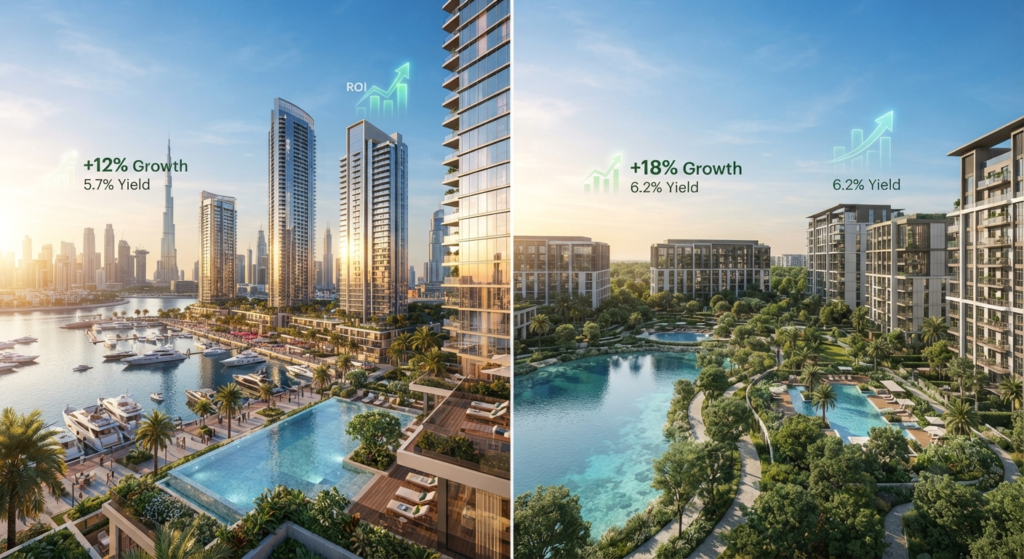
Emaar vs Sobha: Compare Dubai’s top developers for ROI, quality, and investment potential.
1. Company Backgrounds: Emaar vs Sobha
Emaar Properties was founded in Dubai in 1997 and is listed on the Dubai Financial Market. It built Downtown Dubai, the Burj Khalifa, Dubai Marina, Dubai Hills Estate, Arabian Ranches, Dubai Creek Harbour, and Emaar Beachfront, and reports having delivered more than 80,500 residential units since 2002. Its 2025 sales performance came in at a record high, and its listed structure means financials, dividends, and sales backlogs are publicly disclosed every quarter — a transparency advantage few private developers can match.
Sobha Realty traces back to founder P.N.C. Menon, who started an interior-decoration business in Oman in 1976 before expanding into Dubai in 2003. Sobha’s flagship Dubai project is Sobha Hartland, a waterfront community anchoring its UAE portfolio, alongside the District One joint venture. A related but distinct entity, Sobha Limited, is publicly listed in India (BSE/NSE) — the Dubai-facing Sobha Realty itself is privately held, so investors don’t get the same level of quarterly public disclosure as with Emaar. Sobha’s defining trait is backward integration: it owns its construction arms and produces its own joinery, marble, and glass rather than outsourcing to third-party contractors.
Original Insight: Most comparison articles treat “brand reputation” as a soft factor. It isn’t. Emaar’s public listing means its sales backlog (AED 125.2 billion as of early 2026) and dividend payouts are auditable facts you can check before you buy. Sobha’s private structure means its financial health is something you infer from delivery performance and market reputation rather than read from a balance sheet. That distinction alone should shape how much project-level due diligence you do for each.
2. Price Per Square Foot Comparison
Sobha typically prices new launches lower than Emaar for comparable unit types, while Emaar commands a premium tied to community maturity and brand equity. Based on recent DLD transaction patterns, a two-bedroom apartment in a comparable community averages roughly:
- Emaar (Dubai Hills Estate): approximately AED 1.8 million
- Sobha (Sobha Hartland): approximately AED 1.5 million
That gap — Sobha sitting around 10–20% below Emaar for a similar bedroom count — is one of the clearest, most consistent findings across current market analyses. It directly shapes your entry cost and, by extension, your day-one yield.
3. Rental Yield and Cash Flow
This is where the two developers genuinely diverge. Emaar’s premium pricing compresses gross yields, while Sobha’s lower entry price lifts them.
- Emaar: gross rental yields commonly cited in the 5–7% range, with prime Downtown and Marina-adjacent units at the upper end.
- Sobha: gross rental yields typically run 1–2 percentage points higher than comparable Emaar stock, reflecting the lower purchase price rather than higher rents.
Neither developer competes with value-tier, high-yield players like Danube or Azizi, which can post 8–10% gross yields. Emaar and Sobha both sit in the “premium, lower-yield, stronger-appreciation” bracket relative to that segment — the real differentiation is between each other, not against the whole market.
4. Service Charges and Total Cost of Ownership
Yield only tells half the story. Service charges quietly erode net returns, and they differ meaningfully between the two:
- Emaar communities: typically AED 14–25 per sqft annually
- Sobha communities: typically AED 12–18 per sqft annually
Sobha’s slightly lower service charges are partly attributed to its in-house-manufactured, high-efficiency HVAC systems and double-glazed glass, which some owners report cut annual utility costs. Over a 10-year hold, the combined effect of purchase price, service charges, and utility costs can create a total-cost-of-ownership gap of 20% or more between otherwise comparable Emaar and Sobha units. This is a detail almost no surface-level comparison accounts for — most stop at purchase price and yield.
5. Delivery Track Record
Delivery discipline is arguably the single most concrete, checkable metric in this comparison, and it’s where “vertical integration” stops being a marketing phrase and starts being an operating advantage. Some 2025–2026 industry tracking places Sobha’s on-time handover rate at roughly 92%, against roughly 88% for Emaar, with Emaar’s typical villa-project delays running one to three months. Sobha’s owned construction subsidiaries give it tighter control over subcontractor scheduling, which is the most cited reason for the gap.
Important caveat: these percentages come from third-party industry trackers rather than developer-published statistics, and different sources report slightly different figures. Treat them as directional evidence of “both developers deliver reliably, with Sobha having a modest edge,” not as an audited guarantee for any specific project.
6. Construction Quality
Independent home inspectors and buyer-review patterns in 2026 consistently rate Sobha’s internal finishing — joinery, marble, and fit-and-finish — slightly above Emaar’s mass-market product lines. This tracks with Sobha’s manufacturing model: producing its own materials in-house reduces the variability you’d normally see across a supply chain of third-party subcontractors.
Emaar’s quality is far from a weakness — its flagship towers and master-planned villas are built to a high, consistent standard — but its portfolio spans a wider range of price points and finish tiers, which naturally introduces more variation than Sobha’s more concentrated, premium-focused lineup.
7. Resale Value and Liquidity
Emaar’s advantage here is structural rather than a matter of build quality: brand recognition, global buyer awareness, and mature communities like Downtown Dubai and Dubai Marina give Emaar resale stock the deepest, most liquid secondary market in the city. If you need to exit fast — in any market condition — that liquidity has real value, even if you paid a premium going in.
Sobha’s resale market is real and growing, particularly around Sobha Hartland, but it’s shallower and younger. Investors with a 5+ year horizon and no urgent need to sell can capture Sobha’s better day-one economics without feeling the liquidity gap as much; investors who might need to exit in year two or three should weight Emaar’s liquidity more heavily.
8. Comparison Table: Emaar vs Sobha at a Glance
| Factor | Emaar | Sobha |
|---|---|---|
| Founded / Dubai entry | 1997 (Dubai) | 1976 (Oman); Dubai from 2003 |
| Listing status | Publicly listed (DFM) | Privately held (Dubai entity) |
| Typical 2BR price (comparable community) | ~AED 1.8M (Dubai Hills) | ~AED 1.5M (Sobha Hartland) |
| Gross rental yield | ~5–7% | ~6–9% (1–2 pts above Emaar) |
| Service charges | AED 14–25/sqft | AED 12–18/sqft |
| On-time delivery (industry estimate) | ~88% | ~92% |
| Typical delay pattern | 1–3 months (villas) | Shorter, tighter control |
| Construction quality perception | High, but varies by tier | Consistently high (in-house manufacturing) |
| Resale liquidity | Strongest in the market | Growing, still maturing |
| Best 5+ year total ROI | Premium communities can lead | Often leads on 3-year total ROI |
| Best investor fit | Appreciation, liquidity, brand exit | Yield, quality, lower entry cost |
9. Investor Fit Checklist
Use this before you shortlist a specific project:
- Do you need to exit within 2–3 years, or are you comfortable holding 5–10 years?
- Is monthly rental income or long-term appreciation your primary goal?
- Have you priced in service charges over the full hold period, not just year one?
- Have you checked the specific project’s escrow registration on the DLD portal (not just the developer’s overall reputation)?
- Have you reviewed the developer’s completed handovers in the same community, not just the brand overall?
- Does your budget comfortably clear the reservation fee and first payment milestone without stretching your buffer?
- Have you compared at least one Emaar and one Sobha project at a similar price point before deciding?
10. Expert Tips
- Compare net yield, not gross. A Sobha unit advertised at 7% gross can fall close to an Emaar unit’s net yield once you subtract its own service charges — always run both sides through the same net-yield formula before comparing headline numbers.
- Check the specific community, not just the developer. “Emaar” and “Sobha” are umbrella brands; a mid-tier Emaar project and a flagship Emaar community perform very differently, and the same applies within Sobha’s portfolio.
- Ask for the project’s actual handover history, not the developer’s company-wide average. A developer’s overall on-time rate can mask one specific project running badly behind schedule.
- Model a 10-year hold, not just entry-to-handover. Total cost of ownership (price + service charges + utilities) tells a more honest ROI story than purchase price and rental yield alone.
11. Common Mistakes to Avoid
- Assuming “premium developer” automatically means “best ROI” — premium pricing is exactly what compresses yield.
- Comparing an off-plan Sobha launch price against a resold, mature Emaar unit — match project stage and community maturity before comparing numbers.
- Ignoring service charges when calculating expected returns, then being surprised by a lower net yield after year one.
- Treating industry-wide delivery percentages as a guarantee for one specific building — always verify at the project level.
- Buying based on brand loyalty from a home market (India, UK, etc.) rather than the Dubai-specific fundamentals of the actual project.
12. Troubleshooting: What If Your Numbers Don’t Match This Guide
If a broker or listing site is quoting yields notably above the ranges here, ask exactly which costs — service charges, management fees, vacancy periods — have or haven’t been deducted from that figure. If a delivery date has already slipped past what your Sales and Purchase Agreement stated, request the developer’s revised handover notice in writing and check whether penalty clauses in your SPA apply. If your service charge invoice comes in above the ranges quoted here, request a line-item breakdown from the owners’ association rather than accepting a single lump figure — this is standard practice and any legitimate developer-managed building should be able to provide it.
FAQs
Is Emaar or Sobha better for rental yield? Sobha generally posts higher gross rental yields — typically 1–2 percentage points above comparable Emaar units — mainly because its entry prices are lower, not because rents are dramatically higher.
Which developer has better long-term appreciation? Emaar’s flagship communities, particularly Dubai Hills Estate and Dubai Creek Harbour, have shown stronger price-per-square-foot appreciation over the past several years, largely due to brand equity and market maturity.
Is Sobha as safe an investment as Emaar? Both are DLD-registered and sell under RERA escrow protection, so the regulatory safety net is the same. The difference is transparency: Emaar’s public listing means its financials are disclosed quarterly, while Sobha’s Dubai entity is privately held, so due diligence relies more on delivery history and project-level checks.
Which developer has faster property handovers? Industry tracking for 2025–2026 suggests Sobha has a slightly better on-time delivery rate, attributed to its in-house construction model, though both developers deliver the large majority of projects on or near schedule.
Should I buy off-plan from Emaar or Sobha for a quick resale? If your horizon is short (2–3 years), Emaar’s stronger resale liquidity and broader buyer recognition generally make it easier to exit quickly, even though your entry price is higher.
What is the difference between Emaar vs Sobha?
The Emaar vs Sobha comparison highlights two of Dubai’s leading developers. Emaar is known for iconic master-planned communities and strong rental demand, while Sobha is recognized for premium construction quality and luxury developments.
Which offers better ROI, Emaar vs Sobha?
When comparing Emaar vs Sobha, ROI depends on the property’s location, price, and market conditions. Both developers have projects that deliver attractive rental yields and long term capital appreciation.
Is Emaar better than Sobha for investment?
The Emaar vs Sobha investment decision depends on your goals. Emaar is ideal for buyers seeking established communities, whereas Sobha appeals to investors looking for premium quality and exclusive developments.
Which has better rental yield, Emaar vs Sobha?
In the Emaar vs Sobha comparison, Emaar properties often benefit from high tenant demand, while Sobha developments can also generate competitive rental yields in prime locations.
Which developer has better construction quality, Emaar vs Sobha?
The Emaar vs Sobha quality comparison generally favors Sobha for its in-house construction expertise, while Emaar is highly regarded for delivering large-scale communities with world-class amenities.
Is Emaar vs Sobha a good comparison for first time buyers?
Yes. The Emaar vs Sobha comparison helps first-time buyers understand differences in pricing, community lifestyle, investment potential, and long term value before purchasing property in Dubai.
Which is better for luxury living, Emaar vs Sobha?
The Emaar vs Sobha luxury comparison shows that both developers offer premium homes. Emaar is famous for landmark communities, while Sobha is known for elegant design and exceptional craftsmanship.
Should I choose Emaar or Sobha in 2026?
The Emaar vs Sobha choice depends on your budget, preferred location, expected ROI, rental income goals, and long term investment strategy. Both developers remain among Dubai’s most trusted real estate brands.
Key Takeaways
- Sobha typically offers a 10–20% lower entry price than Emaar for comparable units, which lifts its rental yield.
- Emaar typically wins on long-term capital appreciation and resale liquidity, driven by flagship, mature communities.
- Service charges run lower at Sobha (AED 12–18/sqft) than Emaar (AED 14–25/sqft), affecting net yield over a long hold.
- Sobha’s in-house manufacturing model is linked to both its construction-quality edge and its slightly better on-time delivery rate.
- Emaar is publicly listed with disclosed financials; Sobha’s Dubai entity is privately held, shifting due diligence toward project-level checks.
Final Verdict
There is no universal winner between Emaar and Sobha — there’s a better fit for your specific goal. Choose Sobha if you want a stronger cash-on-cash yield, tighter construction quality, and a shorter runway to positive rental income. Choose Emaar if you’re building a 7-to-10-year, appreciation-led position and want the deepest resale market in Dubai if your plans change. Whichever you choose, verify project-level delivery history and escrow registration directly with the DLD before signing — developer-wide reputation is a starting point, not a substitute for due diligence on the specific building.
This article is for general information purposes and does not constitute financial or investment advice. Rental yield, price, and delivery figures are approximate, drawn from publicly available market analyses current as of mid-2026, and can vary by project, unit type, and market conditions. Verify current figures directly with the Dubai Land Department (DLD), the relevant developer, and a licensed financial advisor before making an investment decision.